Consider a scenario where you are purchasing 500 custom t-shirts for a corporate sports tournament or a few 100 shirts for carnival, and you do not know what weight you need to take. Even worse, why do you want to consider any weight at all? Reality check: everything depends on the weight of t-shirts! It explains the comfort, life span, quality of printing, and your shipping bill.
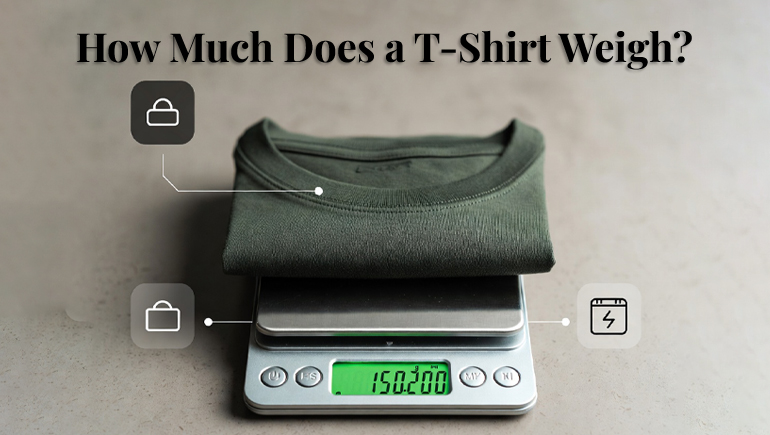
So, are you wondering, how much does a T-shirt weigh? An average cotton t-shirt is 130 to 200 grams, although the difference can be huge depending on style, materials, size, and even the sleeve length of the shirt. Where a light summer tee can be as light as 90 grams, an extra heavyweight tee can break the 300-gram threshold.
Being able to know the difference will save you money, make your customers trust you, and help you create a better brand. Let's dive in to understand what you are actually carrying, wearing, or shipping.
Let’s start with the big question!
Many fashion-loving people are interested in knowing “what is the average weight of a t-shirt?” But the answer is: It varies per multiple factors.
Knowing the below-mentioned weight ranges makes it easier for buyers, retailers, and brands to select the best match for their needs, whether they are producing high-end clothing, bulk retailing, or daily wear.
| T-Shirt Type | Weight (Grams) | Weight (Ounces) |
| Small cotton t-shirt | 110–130 g | 3.9–4.6 oz |
| Medium cotton t-shirt | 130–155 g | 4.5–5.5 oz |
| Large cotton t-shirt | 155–185 g | 5.5–6.5 oz |
| XL cotton t-shirt | 185–220 g | 6.5–7.8 oz |
| Long-sleeve t-shirt | 170–227 g | 6–8 oz |
| T-shirt + shorts (outfit) | 300–500 g | 10.5–17.6 oz |
| Gildan 5000 (Heavy Cotton) | ~180 g | 5.3 oz |
| Gildan G200 (Ultra Cotton) | ~170 g | 6.0 oz |
| Lightweight tee (promotional) | 90–130 g | 3.2–4.6 oz |
| Heavyweight tee (premium) | 200–320 g | 7–11.3 oz |
Note: Weights vary by brand, cut, and fabric composition.
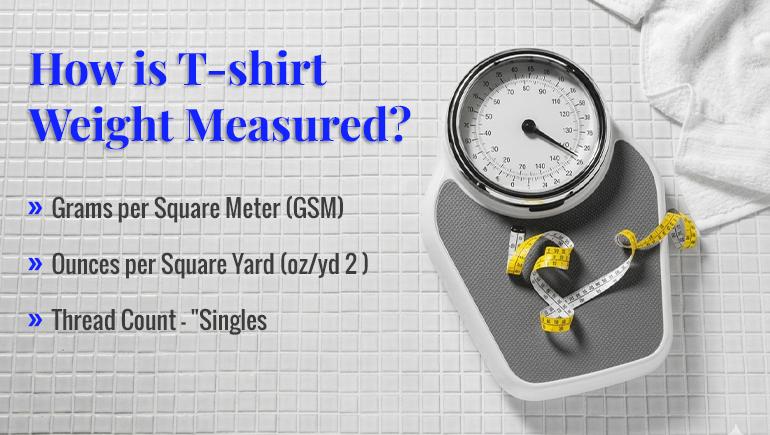
The apparel industry has three systems of measurement. Knowing all three will make you a smarter consumer - a much more confident seller.
Grams per Square Meter (GSM) is the international standard. The greater the GSM, the denser, heavier, and thicker the fabric. You can call it the best sign of fabric quality. Also, the weight is written in most quality labels and product pages; check it out before making a purchase. You can usually read it on sweatshirts.
This is the imperial equivalent of GSM in the US. In fact, this measurement is typical on the label of American brands such as Gildan.
A yard of fabric weighs 1 pound. An average t-shirt weighs between 4 and 7 oz/yd 2. Here's a quick converter: 1 oz/yd² ≈ 33.9 GSM. This means that a 5.3 oz shirt is about 180 GSM - a solid midweight tee!
Single yarns are called the number of threads in it, and the fineness with which the cotton has been twisted. An increased number of singles indicates finer, lighter, and softer yarn. A fashion tee of high quality could be made out of 30 singles. A simple utility tee may consist of 18 singles.
You can take an example of the Gildan 5000 that uses 20-singles yarn.
The weight of that shirt in the rack depends on several factors. And remember, each pick contains a distinct combination of ease, durability, and quality, ranging from lightweight promotional tees to heavier premium cotton shirts. Remember, the following numbers vary for jerseys or gym clothing.
The largest weight-driving force is the material.
Note: Do not compare the GSM of a polyester to cotton. Polyester is thick but has a lower weight. Moreover, it is always important to compare similar materials.
Read More: The Guide to the Softest Clothing Material Fabrics in the World
The most useful method of measuring the density of fabrics is GSM, which is the Grams per Square Meter. The more GSM, the heavier and the thicker the fabric. This is what will directly define the weight of your finished t-shirt to hold in your hands and on your shipping scale.
Bigger shirts use more fabric. That is easy, but the figures run up quickly. A small t-shirt can weigh 110 grams. An XL shirt can weigh 220 grams. That's double! That is a big cost consideration when you are shipping bulk.
Slim-fit shirts also weigh less than relaxed or oversized shirts of the same size, because they take less material to make altogether.
These are details that are most of the time forgotten, but they count:
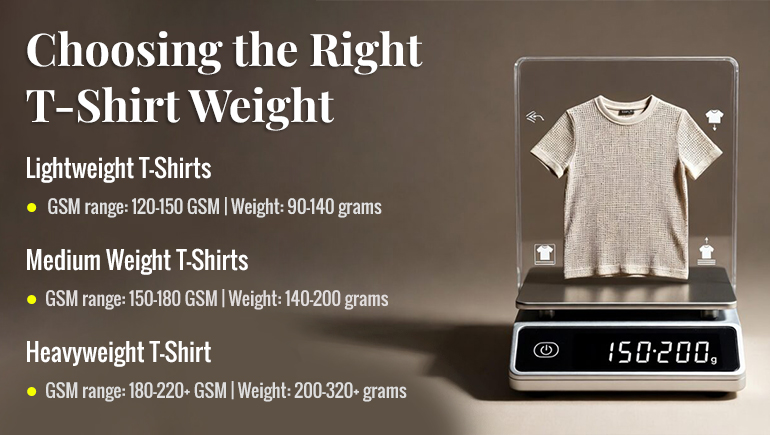
Weight has a significant impact on how a t-shirt feels, functions, and holds up over time. Not all t-shirts are made equal. Selecting the ideal t-shirt for everyday use, comfort, or branding is made simpler by being aware of these variations.
GSM range: 120–150 GSM | Weight: 90–140 grams
The workhorse of summer, events, and athletic wear is lightweight tees. On the skin, they almost feel as light as nothing. Also, the fabric allows air to pass freely through it. They dry fast, fit into a small package effortlessly, and are less expensive to ship.
Additionally, these are the default options in:
GSM range: 150–180 GSM | Weight: 140–200 grams
The medium-weight t-shirts are in between, and the most popular. Not so light as to be cheap! Not so heavy as to be stiff! They strike a balance between comfort, durability, breathability, and print quality.
The average medium cotton t-shirt in this line is approximately 150-170 grams. This is your daily tee - brand tees, custom apparel, workwear, casual style. Also, one of the most popular blank tees in the world, the Gildan 5000, is positioned at 5.3 oz (180 GSM) - in this range. An average Gildan Softstyle has a weight of 138 grams (4.86 oz).
Ideal use: Branded apparel, screen printing, company T-shirts, daily apparel, year-round.
GSM range: 180–220+ GSM | Weight: 200–320+ grams
Big t-shirts are big business. Yes, they are constructed in a durable manner and have a thick fabric. The colors are more vivid and saturated. Besides, screen prints are more long-lasting and do not crack. That is why high-end streetwear brands, workwear, and high-end custom clothing nearly always use heavyweight.
True heavyweight is usually considered to be 5.5 oz/yd 2 (around 186 GSM) and higher. Two industry standards in this category would be the Gildan G200 Ultra Cotton in 6 oz (200 GSM) and the Hanes Beefy-T in 6.1 oz. Specialty street wear tees may be as large as 7.5 oz or more.
Ideal use: High-end merchandise, street wear, uniform, workwear, and cold-weather tracksuits.
You might think, “Why should I care about a 30-gram difference?” But actually, it matters more than you think:
Read Also: 12 Most Popular T-Shirt Types for Women to Try in 2026
The knowledge of how much does a cotton t-shirt weigh and calculating the weight of an average t-shirt is the key to mastering logistics. With lightweight 3.0 oz selections that are ideal in summer and heavyweight and 6.0 oz selections that will still take up the street style in 2025, weight is one of the main guides in defining the style and longevity.
Knowing such technical measures as GSM and yarn singles, you are more likely to guess how the weight of a big cotton t-shirt is going to affect your expenses and your comfort. Always keep in mind that such variables as fabric type, size, and sleeve length all contribute to the final measurement.
If you require any help in choosing the perfect weight to use in your next project, then we have experts at Vel Clothing to help you. To make sure that your clothing is of the highest quality and accuracy, call us at +804-294-1966. It doesn't matter if you’re creating your own clothing brand, making a bulk corporate order, or simply shopping to find the right tee; we are here.